


Honorary Curator Robert Hass
Robert Hass
Honorary Curator, 2026-2027
Appointment Announcement
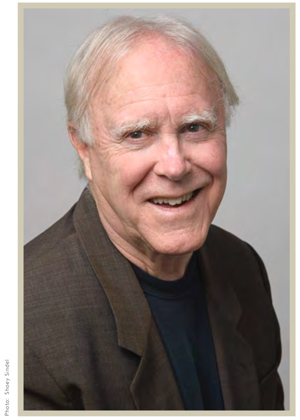 Robert Hass is, first of all, a poet of great eloquence, clarity, and force, whose work is rooted in the landscapes of his native Northern California. Widely read and much honored, he has brought the kind of energy in his poetry to his work as an essayist, translator, and activist on behalf of poetry, literacy, and the environment. Most notably, in his tenure as United States Poet Laure- ate, Robert Hass spent two years battling American illiteracy, armed with the mantra,“imagination makes communities.” He crisscrossed the country speaking at Rotary Club meetings, raising money to organize conferences such as “Watershed,” which brought together noted novelists, poets, and storytellers to talk about writing, nature, and community.
For Hass, everything is connected. When he works to heighten literacy, he is also working to promote awareness about the environment. Hass believes that natural beauty must be tended to and that caring for a place means knowing it intimately. Poets, especially, need to pay constant attention to the interaction of mind and environment.And when he is talking about poetry itself, whether Matsuo Bashô’s or Elizabeth Bishop’s, Hass is both spontaneous and original, offering poetic insights that cannot be found in any textbook.
Robert Hass has published many books of poetry including Field Guide, Praise, Human Wishes, Sun Under Wood, The Apple Trees at Olema, and Summer Snow. His collection of poems entitled Time and Materials won the National Book Award, the Pulitzer Prize. and was chosen by the Atlantic for its list of ‘The Best American Poetry of the 21st Century (So Far).’ He has also written books of essays including, Twentieth Century Pleasures, Now & Then, and A Little Book on Form: An Exploration Into the Formal Imagination of Poetry. His book of essays, What Light Can Do: Essays on Art, Imagination, and the Natural World, is the recipient of the PEN/Diamonstein-Spielvogel Award for the Art of the Essay. Hass translated many of the works of Nobel Prize-winning Polish poet, Czeslaw Milosz including, with David Frick, Poet in the New World: Poems, 1946–1953, and he has edited Selected Poems: 1954-1986 by Tomas Transtromer; The Essential Haiku: Versions of Basho, Buson, and Issa; Poet’s Choice: Poems for Everyday Life; the 2001 edition of Best American Poetry; and Modernist Women Poets: An Anthology (with Paul Ebenkamp). He wrote the introduction to an of selected Walt Whitman poems titled Song of Myself: And Other Poems. He also wrote The Poetic Species: A Conversation with Edward O.Wilson and Robert Hass. His most recent book is A Third Commonness: Essays on Poetry, Poetics, and the Natural World (Copper Canyon Press, 2026).
As US Poet Laureate (1995-1997), his deep commitment to environmental issues led him to found River of Words (ROW), an organization that promotes environ- mental and arts education in affiliation with the Library of Congress Center for the Book. Hass is chairman of ROW’s board of directors, and judges their annual international environmental poetry and art contest for youth; he also wrote the introduction to the poetry collection, River of Words:Young Poets and Artists on the Nature of Things. He is also a board member of International Rivers Network. Robert Hass was chosen as Educator of the Year by the North American Association on Environmental Education and, in 2005, elected to the American Academy of Arts & Sciences.
Awarded the MacArthur “Genius” Fellowship, twice the National Book Critics’ Circle Award (in 1984 and 1997), the Yale Series of Younger Poets in 1973, and the 2014 Wallace Stevens Award. Robert Hass is a Professor of the Graduate School at UC Berkeley.
We are pleased to celebrate Robert Hass, and to bestow this honor from the American Haiku Archives, which seeks to preserve and promote haiku and related poetry throughout the North American continent.
The AHA advisory board is delighted to pay tribute to Robert Hass as the twenty-ninth honorary curator of the American Haiku Archives. To search the collections of the American Haiku Archives online, please visit http://www.library.ca.gov/. For information on donating material to the archives, or other information about its history and past honorary curators, please visit the American Haiku Archives website at www.americanhaikuarchives.org.
Selections of Poetry, Poetics and Criticism by Robert Hass
from The Essential Haiku: Versions of Bashô, Buson, and Issa translated by Robert Hass:
This road—
no one goes down it,
autumn evening.
Bashô
A crow
has settled on a bare branch—
autumn evening.
Bashô
As for the hibiscus
on the roadside—
my horse ate it.
Bashô
The sea darkening—
the wild duck’s call
is faintly white.
Bashô
The old pond—
a frog jumps in,
the sound of water.
Bashô
Taking a nap,
feet planted
against a cool wall.
Bashô
Summer grass—
all that’s left
of warriors’ dreams.
Bashô
Deep autumn—
my neighbor,
how does he live, I wonder?
Bashô
Sick on a journey,
my dreams wander
the withered fields.
Bashô
The two plum trees—
I love their blooming!
one early, one later.
Buson
Coolness—
the sound of the bell
as it leaves the bell.
Buson
Tilling the field;
the man who asked the way
has disappeared.
Buson
Lighting one candle
with another candle—
spring evening.
Buson
That snail—
one long horn, one short,
what’s on his mind?
Buson
The spring sea rising
falling, rising
and falling all day.
Buson
Field of bright mustard,
the moon is east,
the sun is west.
Buson
The sound of a bell
struck off center
vanishes in haze.
Buson
The short night—
broken, in the shallows,
a crescent moon.
Buson
Peonies scattering,
two or three petals
lie on each other.
Buson
Butterfly
sleeping
on the temple bell.
Buson
The snow is melting,
and the village is flooded
with children.
Issa
Goes out,
comes back—
the loves of a cat.
Issa
Climb Mt. Fuji,
O snail,
but slowly, slowly.
Issa
The man pulling radishes
pointed my way
with a radish.
Issa
Don’t kill that fly!
Look—it’s wringing its hands,
wringing its feet.
Issa
I’m going out,
flies, so relax,
make love.
Issa
Even with insects—
some can sing,
some can’t.
Issa
Mother I never knew,
every time I see the ocean,
every time.
Issa
The world of dew
is the world of dew.
And yet, and yet—
Issa
from Field Guide:
“After the Gentle Poet Kobayashi Issa”
New Year’s morning—
everything is in blossom!
I feel about average.
A huge frog and I
staring at each other,
neither of us moves.
This moth saw brightness
in a woman’s chamber—
burned to a crisp.
Asked how old he was
the boy in the new kimono
stretched out all five fingers.
Blossoms at night,
like people
moved by music
Napped half the day;
no one
punished me!
Fiftieth birthday:
From now on,
It’s all clear profit,
every sky.
Don’t worry, spiders,
I keep house
casually.
These sea slugs,
they just don’t seem
Japanese.
Hell:
Bright autumn moon;
pond snails crying
in the saucepan.
“Measure”
Recurrences.
Coppery light hesitates
again in the small-leaved
Japanese plum. Summer
and sunset, the peace
of the writing desk
and the habitual peace
of writing, these things
form an order I only
belong to in the idleness
of attention. Last light
rims the blue mountain
and I almost glimpse
what I was born to,
not so much in the sunlight
or the plum tree
as in the pulse
that forms these lines.
from Praise:
“Meditation at Lagunitas”
All the new thinking is about loss.
In this it resembles all the old thinking.
The idea, for example, that each particular erases
the luminous clarity of a general idea. That the clown-
faced woodpecker probing the dead sculpted trunk
of that black birch is, by his presence,
some tragic falling off from a first world
of undivided light. Or the other notion that,
because there is in this world no one thing
to which the bramble of blackberry corresponds,
a word is elegy to what it signifies.
We talked about it late last night and in the voice
of my friend, there was a thin wire of grief, a tone
almost querulous. After a while I understood that,
talking this way, everything dissolves: justice,
pine, hair, woman, you and I. There was a woman
I made love to and I remembered how, holding
her small shoulders in my hands sometimes,
I felt a violent wonder at her presence
like a thirst for salt, for my childhood river
with its island willows, silly music from the pleasure boat,
muddy places where we caught the little orange-silver fish
called pumpkinseed. It hardly had to do with her.
Longing, we say, because desire is full
of endless distances. I must have been the same to her.
But I remember so much, the way her hands dismantled bread,
the thing her father said that hurt her, what
she dreamed. There are moments when the body is as numinous
as words, days that are the good flesh continuing.
Such tenderness, those afternoons and evenings,
saying blackberry, blackberry, blackberry.
from Time and Materials:
“The Problem of Describing Trees”
The aspen glitters in the wind
And that delights us.
The leaf flutters, turning,
Because that motion in the heat of August
Protects its cells from drying out. Likewise the leaf
Of the cottonwood.
The gene pool threw up a wobbly stem
And the tree danced. No.
The tree capitalized.
No. There are limits to saying,
In language, what the tree did.
It is good sometimes for poetry to disenchant us.
Dance with me, dancer. Oh, I will.
Mountains, sky,
The aspen doing something in the wind.
from July Notebook: The Birds
They are built like exclamation points, woodpeckers.
from Summer Snow:
“Stanzas for a Sierra Morning”
Looking for wildflowers, the white yarrow
With its deep roots for this dry place
And fireweed which likes disturbed ground.
There were lots of them, bright white yarrow
And the fireweed was the brilliant magenta
Some women put on their lips for summer evenings.
The water of the creek ran clear over creekstones
And a pair of dove-white plovers fished the rills
A sandbar made in one of the turnings of the creek.
You couldn’t have bought the sky’s blue.
Not in the silk markets of Samarkand. Not
In any market between Xian and Venice.
Which doesn’t mean that it doesn’t exist.
Isn’t that, after all, what a stanza is for,
So that after a night of listening, unwillingly,
To yourself think, you can walk, slightly hungover,
Through some morning market, sipping tea,
An eye out for that scrap of immaculate azure.
from Twentieth Century Pleasures
from “Images”
“ . . . Often enough, when a thing is seen clearly, there is a sense of absence about it—it is true of impressionist painting—as if, the more palpable it is, the more some immense subterranean displacement seems to be working in it; as if at the point of truest observation the visible and the invisible exerted enormous counterpressure. Some of Buson’s poems seem to comment on this directly:
Mustard flowers
no whale in sight,
the sea darkening.
Images haunt. There is a whole mythology built on this fact: Cézanne painting till his eyes bled, Wordsworth wandering the Lake Country hills in an impassioned daze. Blake describes it very well, and so did the colleague of Tu Fu who said to him, “It’s like being alive twice.” Images are not quite ideas, they are stiller than that, with less implication outside themselves. And they are not myth, they do not have that explanatory power; they are nearer to pure story. Nor are they always metaphors; they do not say this is that, they say this is.”
from What Light Can Do
from “‘Howl’ at Fifty”
“. . . the reader of this poem . . . may reflect . . . that this wild text of a wild new generation is about a son’s acceptance of his mother’s madness and of the sadness of her life, like a yellowed paper rose on a coat hanger in an empty room. And about a man’s acceptance of his own sexuality and about the shame of the punishing, warmongering, body-hating and money-grubbing forces in what s supposed to be a free and generous republic. And about the power if love and the way that suffering teaches us tenderness.
“The Honorable Clayton W. J. Horn, who presided at the Howl trial, . . . found the poem not obscene and Ferlinghetti not guilty. The result of the trial, of course, was that Howl became a national cause célèbre, and San Francisco got the reputation, curiously, of a place especially hospitable to poetry. It also helped give definition to a new generation. When the verdict was announced, the San Francisco Chronicle reported, it drew applause from a courtroom packed with ‘the most fantastic collection of beards, turtlenecked shirts and Italian hairdos every to grace the grimy precincts of the Hall of Justice.’”
Selected books by Robert Hass:
Hass, Robert. Field Guide. New Haven, CT: Yale University Press, 1973.
———. Praise. New York: Ecco Press, 1979.
———. Twentieth Century Pleasures: Prose on Poetry. New York: Ecco Press, 1984.
———. Human Wishes. New York: Ecco Press, 1989.
———. The Essential Haiku: Versions of Bashô, Buson, and Issa. Edited and translated by Robert Hass. New York: Ecco Press, 1994.
———. Sun Under Wood: New Poems. New York: Ecco Press, 1996.
———. Time and Materials: Poems 1997–2005. New York: Ecco, 2007.
———. Now and Then: The Poet’s Choice Columns. New York: Ecco, 2007.
———. The Apple Trees at Olema: New and Selected Poems. New York: Ecco, 2010.
———. What Light Can Do: Essays on Art, Imagination, and the Natural World. New York: Ecco, 2012.
________. Summer Snow: New Poems. New York: Ecco, 2020.
________. A Third Commonness: Essays on Poetry, Poetics, and the Natural World. Port Townsend, WA: Copper Canyon Press, 2026.
Hass, Robert, and Edward O. Wilson. The Poetic Species: A Conversation with Edward O. Wilson and Robert Hass. New York: Liveright, 2014.
Hass, Robert. A Little Book on Form: An Exploration into the Formal Imagination of Poetry. New York: Ecco, 2017
